By: Jessica Zambarano
Cannabis Operations Are Entering an Era of Manufacturing Discipline
The cannabis industry is evolving. Markets are maturing, margins are tightening and regulatory scrutiny is expanding. What began as a race to establish brands, scale production, and meet demand is becoming something much more disciplined – a manufacturing industry defined by quality, consistency, and operational efficiency.
Operators are under growing pressure to run smarter businesses, not just bigger ones.
Data-Driven Operations Are Becoming the New Competitive Advantage in Cannabis
This shift toward data-driven operations means tighter process control, better batch consistency, more predictable outcomes, less waste, and faster decision-making. In short, the industry is moving toward a more profitable operating model driven by access to data.
Forward-looking operators are increasingly treating cannabis production as a measurable system rather than a variable craft. They are building processes that can be monitored, benchmarked, refined, and repeated, creating operational models designed to protect quality while improving margins.
Across cultivation, extraction, manufacturing, and finished goods production, access to timely operational data is becoming a meaningful competitive advantage.
Operational Data Is Reshaping Cultivation, Manufacturing, and Quality Systems
Operational data is shaping nearly every corner of cannabis production. From cultivation to extraction to finished goods manufacturing, operators are increasingly using measurement and process insights to improve consistency, reduce waste, and make smarter business decisions.
In cultivation, growers are using data to optimize environmental conditions and crop performance by monitoring:
- Irrigation timing and substrate moisture
- Canopy temperature and humidity
- Light intensity and photoperiod strategy
- Vapor pressure deficit (VPD)
- Room-by-room yield trends and production benchmarks
These insights help reduce plant stress, improve consistency, and maximize yield and cannabinoid value per square foot.
In extraction and post-harvest processing, operators are measuring key production variables such as:
- Cannabinoid recovery rates
- Throughput and production efficiency
- Solvent usage and extraction efficiency
- Winterization losses
- Distillation and refinement performance
Over time, even small process improvements can translate into meaningful gains in yield, consistency, and profitability at scale.
In manufacturing and finished goods production, data is helping operators improve:
- Formulation accuracy
- Batch homogeneity and product consistency
- Ingredient verification and input quality
- SKU profitability and production planning
- Inventory forecasting and demand alignment
Operational data creates visibility that helps manufacturers increase quality, reduce waste, protect margins, and make more informed production decisions.
Data-Driven Process Control Is the Foundation of Modern Cannabis Manufacturing
The broader movement toward measurement and process control in cannabis mirrors the evolution of other regulated manufacturing industries.
Industry organizations such as the National Cannabis Industry Association continue to emphasize the importance of operational discipline, quality systems, and scalable business practices as the cannabis sector matures.1 At the same time, ASTM International continues developing cannabis-specific standards that support repeatable quality systems.2 In addition, the U.S. Food and Drug Administration has long emphasized a science-based approach to manufacturing quality – one built around understanding critical process variables, monitoring performance, and continuously improving process control throughout production.3
Cannabis is increasingly moving toward that same operational model.
Practical cannabis operators can approach this evolution by adopting a simple yet powerful operating framework: Measure → Analyze → Optimize → Repeat.
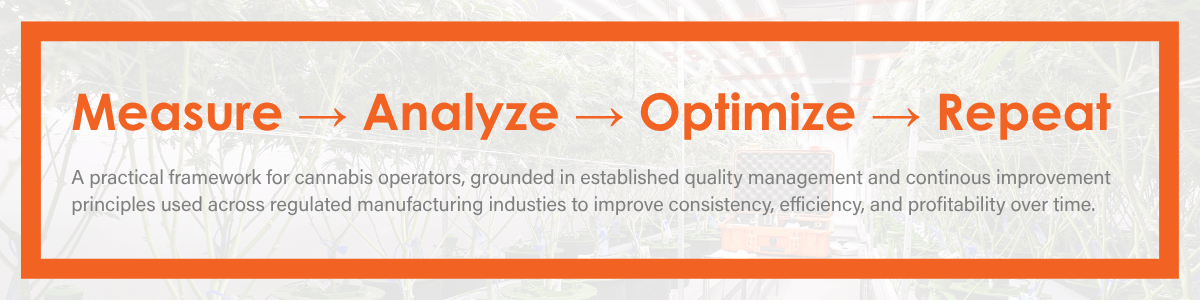
At its core, the concept is straightforward. Operators measure the variables that matter, analyze the data, optimize processes based on those insights, and repeat that cycle as part of normal operations.
While simple in structure, this model is grounded in established quality management and continuous improvement principles used across regulated manufacturing industries, to improve consistency, efficiency, and profitability over time.
Measured Improvements: Real-World Examples of Data-Driven Cannabis Operations
The impact of operational measurement and process optimization is already being demonstrated across the cannabis industry, where data-driven improvements are delivering measurable gains in yield, efficiency, and profitability.
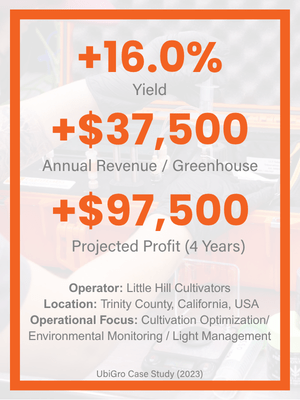
Cultivation Optimization:
Little Hill Cultivators in Trinity County reported a +16.0% increase in dry yield after implementing controlled environmental optimization strategies, translating to approximately +$37,500 in additional annual revenue per greenhouse and a projected +$97,500 in profit over four years.
Source: UbiGro, “+16% Boost in Cannabis,” 2023.4
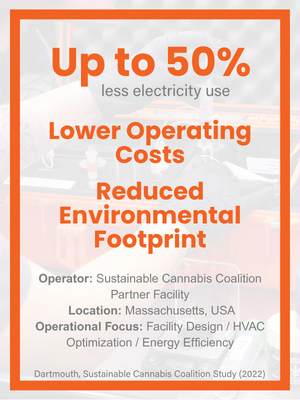
Facility Efficiency:
A commercial cultivation project supported by Sustainable Cannabis Coalition in Massachusetts demonstrated that facility redesign informed by operational data could reduce electricity use by up to 50%, significantly lowering operating costs while maintaining environmental control performance.
Source: Dartmouth College, “Radically Efficient Cannabis Cultivation Facility Design”, 2022.5
Extraction Optimization:
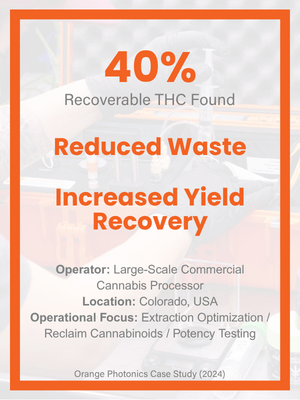
A large-scale commercial processor using in-house testing discovered that approximately 40% of the THC remained in discarded biomass, revealing a recoverable value stream significant enough to pay for the analytical instrumentation in a single use while uncovering opportunities to improve extraction efficiency moving forward.
Source: Orange Photonics, “Case Study: Optimizing Cannabis Extraction with In-House Potency Testing,” 2024.7
These examples reinforce a broader point: when cannabis operators measure what matters, they are better positioned to optimize processes, reduce waste, and build stronger, more profitable businesses.
Potency Testing Is Evolving from Compliance Requirement to Operational Tool
For years, cannabis producers have relied heavily on third-party labs for potency information. While essential for compliance, outside lab results often arrive days, or even weeks, after key production decisions have already been made.
At the same time, potency data is becoming increasingly important to operations. According to Grand View Research, potency testing was the largest revenue-generating service segment in cannabis testing in 2025, underscoring how central cannabinoid measurement has become to the modern cannabis supply chain.7
The evolution of the industry is changing how operators think about potency data.
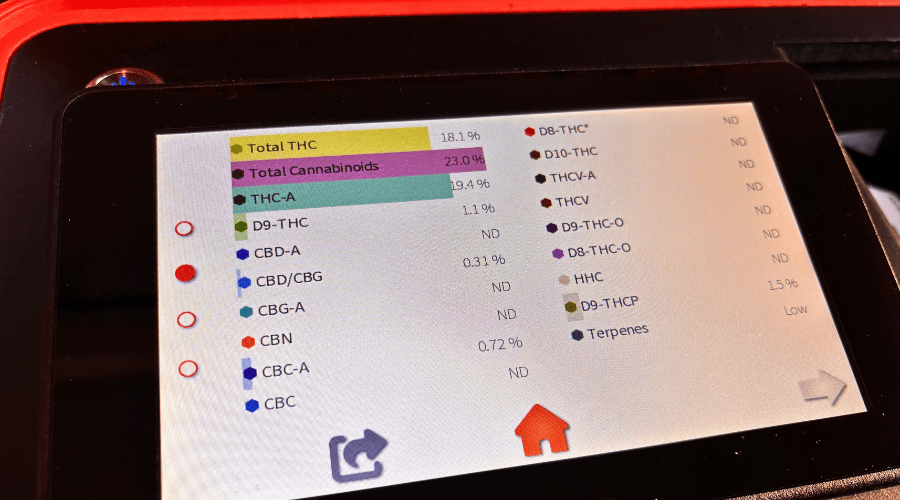
Rather than relying exclusively on off-site laboratory analysis, cannabis operators are increasingly bringing analytical capability closer to production, or at-line. With in-house testing, potency data can inform decisions in real-time, while cultivation, extraction, formulation, and manufacturing processes are still in motion.
At-line data gives operators immediate visibility into variables that directly affect quality, yield, consistency, and profitability. With real-time potency data, operators can:
- Identify ideal harvest windows based on cannabinoid development
- Monitor extraction efficiency and catch process drift early
- Verify ingredient potency and incoming raw material quality
- Confirm formulations are on target before full-scale production
- Detect inconsistencies before batches move downstream
- Tighten batch-to-batch consistency across finished goods
These are not compliance problems—they are process control problems.
And increasingly, cannabis operators are solving them the same way sophisticated manufacturers in food, beverage, and pharmaceuticals do – by increasing on-site analytical capabilities.
Real-time potency data can change how an operation runs. It transforms testing from a final checkpoint into an operational tool that actively improves performance throughout production and shifts operators toward proactive process optimization.
Smarter Operations Will Define the Next Generation of Cannabis
The next generation of successful cannabis operators will not win solely on branding, distribution, or scale. They will outperform because they build systems that are measurable, repeatable, and efficient – operations where decisions are informed by data, not delayed by it.
The future of cannabis manufacturing belongs to operators who can measure what matters, when it matters, and then act on that information faster than the competition.
In the years ahead, quality, efficiency, and consistency will become increasingly important competitive differentiators. However, access to timely, actionable data may matter most of all.
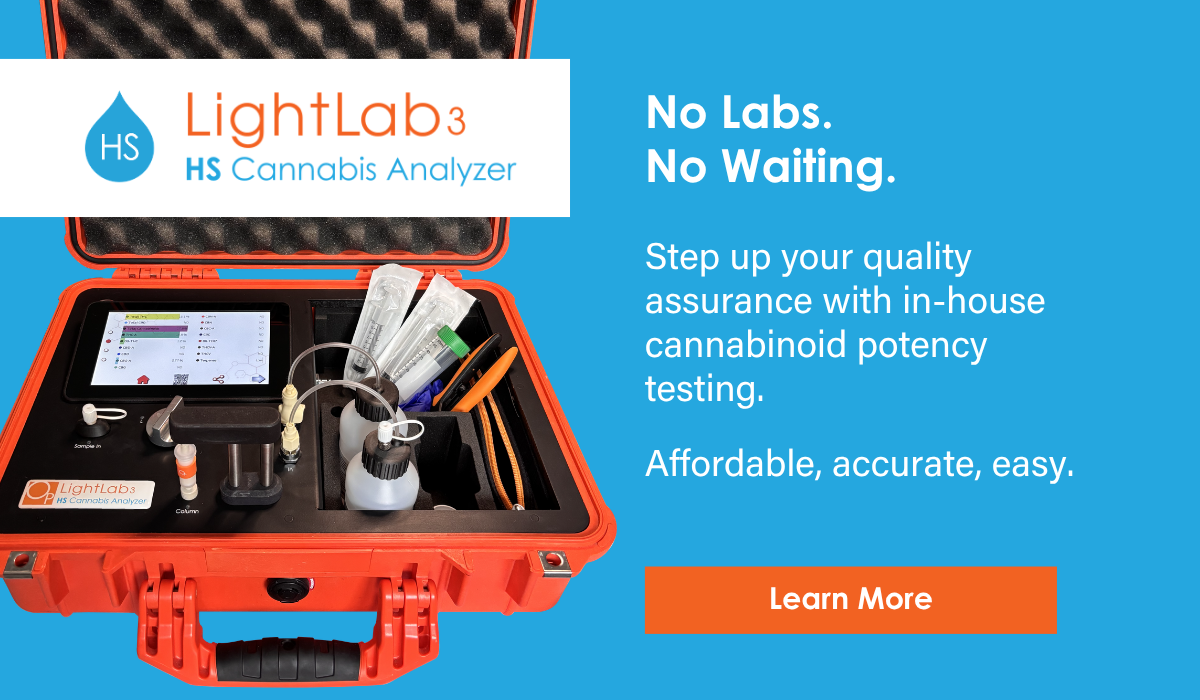
Data drives process improvements. Bring cannabinoid testing in-house with LightLab 3 HS Cannabis Analyzer.
1National Cannabis Industry Association (NCIA), best practices and policy resources, accessed May 2026. https://thecannabisindustry.org/
2ASTM International, Committee D37 on Cannabis Standards, established 2017; accessed May 2026. https://www.astmcannabis.org/committee-d37-on-cannabis/
3U.S. Food and Drug Administration (FDA), Manufacturing Quality and Science-Based Process Control Resources, accessed May 2026. https://www.fda.gov/
4UbiGro, “+16% Boost in Cannabis,” authored by Suzie Elles, published May 10, 2023, accessed May 2026. https://ubigro.com/16-boost-in-cannabis/
5Dartmouth College ENGS 89/90 Report, Radically Efficient Cannabis Cultivation Facility Design, authored by Jason Carpio et al., sponsored by Sustainable Cannabis Coalition, published 2022, accessed May 2026. https://digitalcommons.dartmouth.edu/engs89_90/44/
6Orange Photonics, “Case Study: Optimizing Cannabis Extraction with In-House Potency Testing,” organizational authorship, published 2024, accessed May 2026. https://orangephotonics.com/case-study-optimizing-cannabis-extraction-with-lightlab-3/
7Grand View Research, Cannabis Testing Market Size, Share & Trends Analysis Report, 2025 edition. https://www.grandviewresearch.com/industry-analysis/north-america-legal-cannabis-market-report